Purpose
To honor a living architect or architects whose built work demonstrates a combination of those qualities of talent, vision, and commitment, which has produced consistent and significant contributions to humanity and the built environment through the art of architecture.
The international prize, which is awarded each year to a living architect/s for significant achievement, was established by the Pritzker family of Chicago through their Hyatt Foundation in 1979. It is granted annually and is often referred to as “architecture’s Nobel” and “the profession’s highest honor.”
The award consists of $100,000 (US) and a bronze medallion. The award is conferred on the laureate/s at a ceremony held at an architecturally significant site throughout the world.
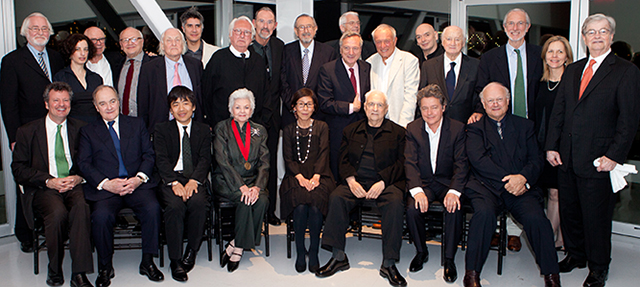
Back row, left to right Juhani Pallasmaa*, Karen Stein*, Rolf Fehlbaum*, Jorge Silvetti* Hans Hollein, Alejandro Aravena*, Richard Meier, Thom Mayne, Cesar Pelli*, Rafael Moneo (behind-Jan Utzon, representing Jorn Utzon) Richard Rogers, Jean Nouvel, Kevin Roche, Renzo Piano, Martha Thorne**, Bill Lacy**. (Photo taken in 2010)
*Juror
** Executive Director
***Founder
History
The Prize was founded in 1979 by Jay A. Pritzker (1922–1999) and his wife, Cindy Pritzker (1923–2025), who believed that a meaningful prize would elevate architectural excellence and public awareness to the role architecture plays in shaping society. Their vision was to honor architects whose work advances humanity and the built environment.
Central to the integrity and enduring impact of the Prize is its jury, which acts independently. Since its inception, the Prize was established with a structure intentionally conceived to safeguard the jury’s autonomy in its deliberations and proceedings. The jury, composed of internationally respected professionals from a range of disciplines, has always and will continue to conduct its work confidentially and free from external influence.
Many of the procedures and rewards of the Pritzker Prize are modeled after the Nobel Prize. Laureates of the Pritzker Architecture Prize receive a $100,000 grant, a formal citation certificate, and since 1987, a bronze medallion. Prior to that year, a limited edition Henry Moore sculpture was presented to each Laureate.
The prize takes its name from the Pritzker family, whose international business interests are headquartered in Chicago. The family has long been known for their support of educational, scientific, medical, and cultural activities.

Cindy Pritzker, an Icon
Ceremony
The official ceremony granting the award takes place every year, usually in May, at an architecturally significant site throughout the world. The choice of location of the ceremony reinforces the importance of the built environment while providing a unique setting for the ceremony. The presentation ceremonies move around the world each year, paying homage to the architecture of other eras and/or works by previous laureates of the prize. As the ceremony locations are usually chosen each year before the laureate is selected, there is no intended connection between the two.
The invitation-only event is attended by international guests and guests from the host country. The ceremony itself normally consists of welcoming remarks usually from a dignitary of the host country; comments from the jury chairman; the presentation of the prize by Tom Pritzker; and an acceptance speech from the Laureate.
Special ceremony videos have been created since 2020 to allow an unlimited international audience participate in the honoring of each Laureate by viewing full ceremony remarks and additional insights from past Laureates and Jurors.
The laureate receives $100,000 and also a bronze medallion. The bronze medallion awarded to each Laureate of the Pritzker Architecture Prize is based on designs of Louis Sullivan, famed Chicago architect generally acknowledged as the father of the skyscraper. On one side is the name of the prize. On the reverse, three words are inscribed, “firmness, commodity and delight,” recalling Roman architect Vitruvius' fundamental principles of architecture of firmitas, utilitas, venustas.